Melayu
 English
 français
 Deutsch
 italiano
 русский
 español
 português
 العربية
 Nederlands
 한국의
한국의 Romania
 Bulgaria

Against the backdrop of increasingly strained global water resources and ever-tightening environmental regulations, Zero Liquid Discharge (ZLD) has become the ultimate goal of industrial wastewater treatment. It means that all water discharged from the system must be recovered and reused, with no liquid waste released to the environment. On this journey toward "making every drop count," electrodialysis (ED), leveraging its unique advantages, is evolving from a "concentrator" into a "resource converter," playing an increasingly critical role.
Traditional ZLD processes typically rely on technologies such as multi-effect evaporation and crystallization to achieve final water-salt separation. However, such methods are extremely energy-intensive, as heating water into steam consumes vast amounts of thermal energy. The first key role of electrodialysis is to serve as an efficient membrane-based pre-concentration unit operating at ambient temperature and pressure.
Electrodialysis can further concentrate high-salinity wastewater, substantially increasing salt concentration while significantly reducing water volume. This directly lowers the amount of water entering the downstream evaporation and crystallization system, thereby drastically cutting the thermal energy consumption and operating costs of the entire ZLD system.
In a pilot project at the Zhangjiagang Industrial Park, electrodialysis was proven to effectively reduce the volume of wastewater entering the thermal evaporation stage. A study on flue gas desulfurization wastewater from coal-fired power plants also confirmed that adopting an "ED-RO" coupled process can achieve an overall wastewater recovery rate of 70%, with the concentrate produced by ED further treated through evaporation and crystallization to realize ZLD, while maintaining a relatively low energy consumption per ton of water.
If concentration is the fundamental skill of electrodialysis, then the emergence of bipolar membrane electrodialysis (BMED) has endowed it with the "Midas touch" — a magical ability to turn waste into treasure. This represents the most remarkable role upgrade of electrodialysis technology in the ZLD era.
At the core of BMED lies a specialized "bipolar membrane." Under an electric field, this membrane can directly dissociate water molecules into hydrogen ions (H⁺) and hydroxide ions (OH⁻). These ions then combine with the migrating salt ions, directly converting the waste salt solution into high-purity acid (e.g., hydrochloric acid, HCl) and base (e.g., sodium hydroxide, NaOH), with no additional chemicals required throughout the process.
This role transformation is profoundly significant. It turns ZLD from an environmental compliance burden into a resource recovery process. The acid and base produced can be reused on-site within the plant (e.g., for ion exchange resin regeneration, pH adjustment) or sold externally as products, greatly improving the economic viability of the process. In one study, a ZLD system integrating BMED was able to recover chemicals such as sulfuric acid and calcium hydroxide and recycle them back into the production process, significantly enhancing the level of circular economy.
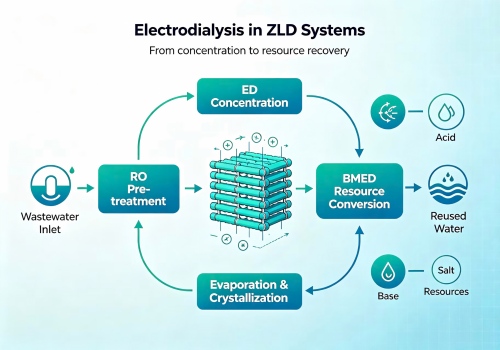
Today, the role of electrodialysis is no longer an isolated one; instead, it serves as a core platform deeply integrated with reverse osmosis (RO), chemical precipitation, ion exchange, and other technologies to collectively build a chemically self-sufficient, closed-loop treatment system.
Synergistic Effect: In a typical integrated system, upstream RO performs preliminary desalination, ED (or BMED) carries out deep concentration and resource conversion, while the acid and base generated on-site by BMED can be used for chemical dosing or membrane cleaning in other units, forming a virtuous cycle.
Of course, under the ambitious goal of zero liquid discharge, electrodialysis technology is not without its shortcomings.
Especially when treating wastewater with high hardness and high organic content, dense fouling layers readily form on membrane surfaces. Although the polarity reversal function of EDR can alleviate scaling, its effectiveness against organic fouling and biofouling remains limited.
Conventional electrodialysis lacks strong separation selectivity for ions of different valences. In scenarios where monovalent salts (e.g., NaCl) and divalent salts (e.g., Na₂SO₄) need to be recovered separately, the performance of existing selective electrodialysis (SED) membranes still has room for improvement.
Each ZLD project differs in water quality, volume, and reuse objectives. Electrodialysis process parameters — such as voltage, flow rate, and membrane stack configuration — require tailored design. The lack of standardized solutions means that each project is essentially a "custom development," driving up design costs and implementation risks.
However, it is foreseeable that with continuous advances in membrane materials, process design, and intelligent control, electrodialysis will evolve from an auxiliary concentration tool into the core engine for achieving resource-oriented ZLD, truly becoming an indispensable key technology for the green transformation of future industries.
1.What is the evolving role of electrodialysis (ED) in ZLD?
ED is transforming from a simple wastewater concentrator into a core platform for resource recovery in zero liquid discharge projects.
2.How does conventional ED optimize traditional ZLD processes?
ED concentrates high-salinity wastewater at ambient temperature, cutting the feed volume for evaporation and crystallization, so energy consumption and operating costs are reduced.
3.How does ED form a closed-loop treatment system?
ED works with RO, precipitation and ion exchange. Acid and base generated by BMED can be reused on-site, creating a self-sufficient circular treatment loop.



 IPv6 RANGKAIAN DISOKONG